First, I want to share that NRM will be celebrating the International Year of Rangelands and Pastoralists on Friday April 17 at McCrory Gardens with an opportunity to visit the department in the afternoon. All are welcome and more details are below.
Second, I will be retiring as NRM Dept Head with my last day being Aug 21, 2026. I want to thank you ALL for how you have helped our department pursue our land grant trifold mission over this last decade! It has been an honor to serve in this leadership role.
I am exceptionally proud of the work we have accomplished together to rebuild NRM over the last 10 years thanks to many of you. We are now fully staffed since 2019 and collectively we have hired great colleagues, offer outstanding undergraduate programs and experiential learning opportunities, have growing graduate student training programs and have excelled with our grant awards, publication record, and M.S. and Ph.D. degrees completed.
I want you to know that I am committed to ensuring a smooth transition for the department. Dean Cassady has already begun initiating a search committee.
It has been a pleasure and privilege to interact with you all and I wish everyone success in their life pursuits. I am excited to start my next chapter as well.
Growing South Dakota spotlights: International Year of Rangelands and Pastoralists
Winter 2026 Issue | Growing South Dakota
NRM has several articles on our research and outreach endeavors in the winter issue of Growing South Dakota highlighting our diverse work in Rangelands, which is attached here. NRM faculty noted are Drs. Sean Di Stefano, Krista Ehlert, Jeff Martin and Lora Perkins along with their collaborators.
Researchers investigating mule and white-tailed deer populations in South Dakota
December 16, 2025 | sdstate.edu
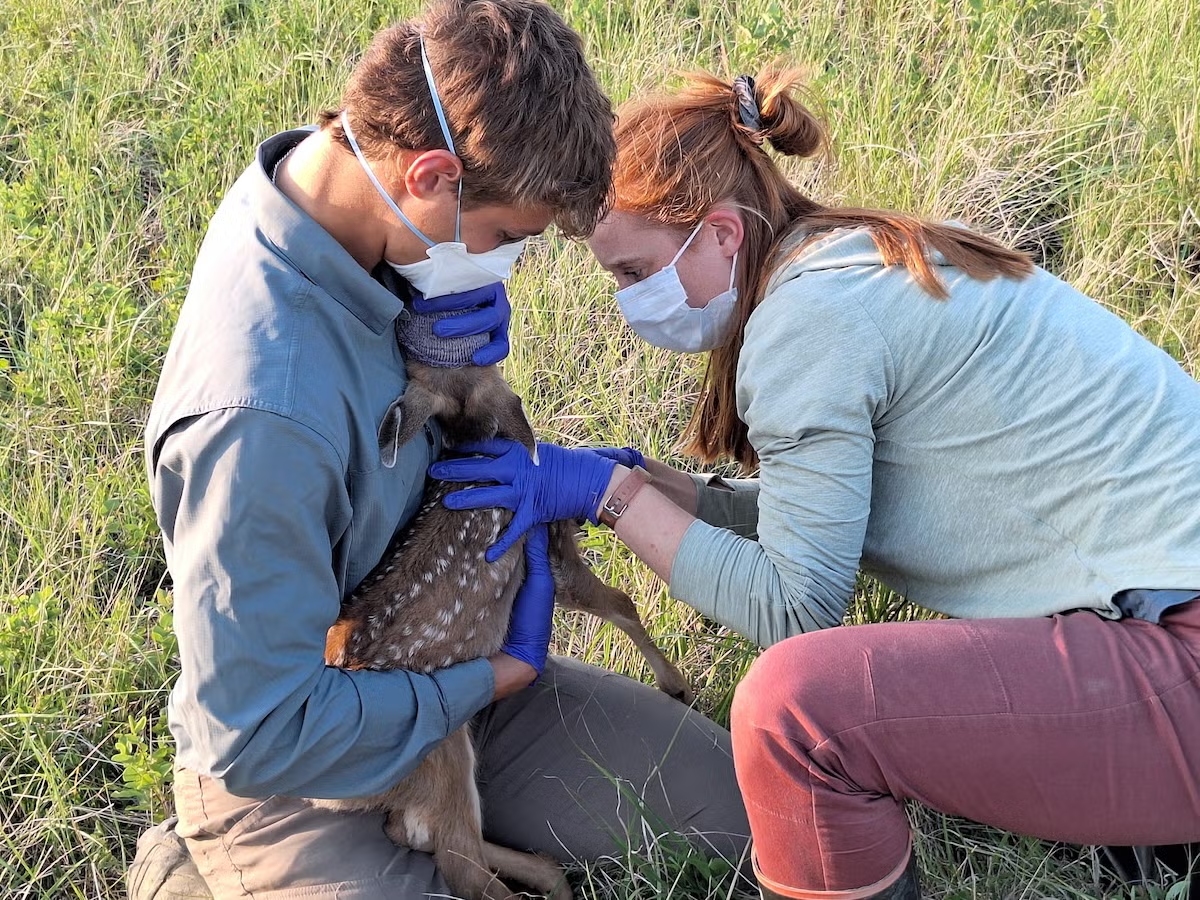
NRM Researchers are leading a new study to better understand survival rates of mule deer and white-tailed deer fawns in western South Dakota. Using thermal-camera equipped drones and GPS collars, the SDSU team, led by Dr. Bill Severud and M.S. student Helen Krueger in collaboration with South Dakota Game, Fish and Parks, tracked juvenile deer in areas where the two species overlap. Early results show low fawn survival rates during the first months of life, offering new insight into predator-prey dynamics and population trends. The research will help inform future wildlife management decisions across the state and represents the first study of mule and white-tailed deer hybridization in South Dakota.
This study was highlighted in Alumni & Foundation's STATE Magazine.
NRM had a strong presence at the annual National Bison Association Winter Conference held in Colorado, the largest bison-focused conference of the year. Graduate students, faculty, and Extension professionals from NRM and SDSU shared cutting-edge research and outreach efforts with producers, researchers, and industry leaders from across the country. Department Head Michele Dudash was able to witness first-hand the exceptional impact we are having on the bison community. Attendees included M.S. students (Angie Lemminger and Audrey Van Zelfden), postdocs (Drs. Ashlynn Smith and Alex Shupinski), faculty (Drs. Rachel Short and Jeff Martin) and staff member Stacy Hadrick.
Overall, there were 19 from NRM that attended the Midwest Fish and Wildlife Conference in Indiana. Faculty (Drs. Alison Coulter, Dave Coulter and Chris Cheek) attended along with 2 undergraduates (Brindy Bolander and Kaden Ball), and 14 graduate students (Kayla Rabchenia, Cali Engel, Natalie Liberati, Thea Klarenbeek, Logan Zebro, Sylas Abarr, Mikenna Henderson, Carter Dollen, Claudia Mushel, Hannah Mulligan, Vic Pineiro, Emily Macklin, Ashley Fazekas and Helen Krueger) presented their research at this meeting. The students also brought home a variety of awards including 7 receiving various travel awards, and 1 Fenske winner.
18 members of NRM participated in the International Society of Rangeland Ecology and Management (SRM) meeting in California in early February. Attendees included faculty (Drs. Michele Dudash, Josh Leffler, Lan Xu and Sean Di Stefano), 6 undergraduates (Ava Brenner, Zane Barker, Lillie Armbruster, Nick Busse, John Sump and Andrew Dammen) who competed and/or presented their research and 8 graduate students (Ali Karnes, Rylie Franklin, Tyler Geltmacher, Walter Wafula, Ash Morell, Ethan Rising, Payton Lemme and Tori Dungey) who presented their research. Our undergraduates placed 5th out of 23 schools in the URME exam, undergraduate John Sump placed 2nd in the extemporaneous speaking contest and M.S. student Tori Dungey placed 2nd in the oral presentation competition. Congratulation to all!
The Natural Resource Law Enforcement (NRLE) Club has rebooted! Open to all NRM majors, the club offers hands-on opportunities to develop skills in communication, resource management, public service, and law enforcement procedures. Members can also participate in field activities like trap shooting and night scenarios. Meetings are held Thursdays at 6 p.m. in McFadden Biostress SNP102, providing a space to learn, practice, and connect with fellow students interested in conservation and natural resource law enforcement.
Park Interpretation & Management Club hosted Chainsaw Workshop
November 2025 | Brookings Campus
In November, the Park Interpretation & Management Club hosted a hands-on chainsaw workshop led by Dr. John Ball that gave students the opportunity to learn, practice, and build confidence in essential chainsaw skills used in the field.
In this presentation of the Northern Plains Water Voice series, hosted by David Kringen, SDSU Extension Water Resources Field Specialist, David talks with Dr. Christopher Cheek about how roads affect fish communities' connectivity in South Dakota.
The New York Times features: Burning the Prairie to Save It
December 9, 2025 | The New York Times
The importance of prescribed burning on South Dakota’s prairie has gained national attention, with The New York Times recently highlighting the work led by NRM Extension Specialists, Pete Bauman and Sean Kelly,and local landowners. As Eastern red cedar trees continue to spread across native grasslands. The article spotlights community-based Prescribed Burn Associations efforts to restore prairie ecosystems, improve grazing land, and reduce wildfire risk.
Photo by Joe Dickie Photography - A training session at South Dakota State University’s Oak Lake Field Station in 2023.
SDSU Extension publishes research on native plants for bird habitat
January 6 | sdstate.edu
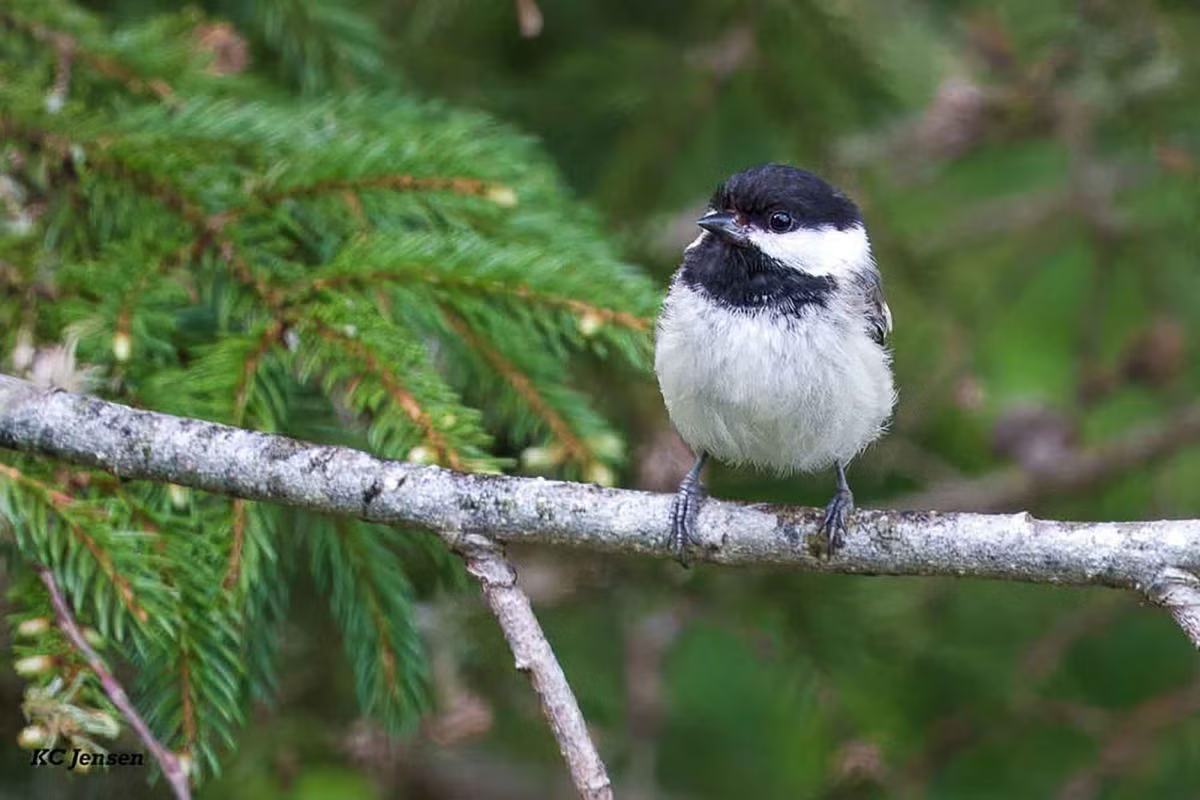
SDSU Extension has published new research highlighting how native plants support bird habitat across South Dakota. The publication is a collaborative effort involving SDSU Extension (Robin Buterbaugh and Sara Ogan) and Perkins's Lab (Dr. Lora Perkins, Ph.D. student Bret Lang and M.S. student Anna Manson) and examines how native grasses, flowers, shrubs, and trees provide essential food, shelter, and nesting resources for birds while supporting native insect populations: Native Plants for Bird Habitat in South Dakota
For example, the black-capped chickadee feeds its chicks 350-570 caterpillars every day, which requires suitable habitat. (Photo by KC Jensen, former SDSU faculty)
State Recognition Highlights SDSU’s Leadership in Black Hills Conservation
January 26 | South Dakota Legislature
This year, the South Dakota Legislature adopted House Concurrent Resolution 6003, recognizing the importance of conservation and restoration practices in addressing water shortages and wildfire mitigation in the Black Hills and commending the organizations engaged in this work. For context, SDSU faculty (Drs. Krista Ehlert and Jamie Brennan) completed a 3-year Sustainable Agriculture Research and Education (SARE) project this year focused on these science-based approaches, M.S. student Tori Dungeyand Dr. Ehlert have been working closely with the Black Hills Watershed Collaborative on restoration efforts in the Hills. Together, this underscores the role of SDSU-led research and partnerships in advancing resilient water resources and healthier landscapes across the region: 2026 House Concurrent Resolution 6003 | South Dakota Legislature
Beaver Dam Analogues are playing an important role in Black Hills conservation. (Photo by Tori Dungey)
![UR119_2024_NRM HubSpot Header 24[2]](https://rabbitfood.sdstate.edu/hs-fs/hubfs/UR119_2024_NRM%20HubSpot%20Header%2024%5B2%5D.jpg?upscale=true&width=1200&upscale=true&name=UR119_2024_NRM%20HubSpot%20Header%2024%5B2%5D.jpg)